Indiana EMS protocols,
in your pocket.
Offline, county-specific protocols for Indiana EMS providers — searchable, with a full medication reference, hospital finder, and study tools built in.
Covering 1 county in Indiana · Protocols current as of September 10, 2026
See it in the field
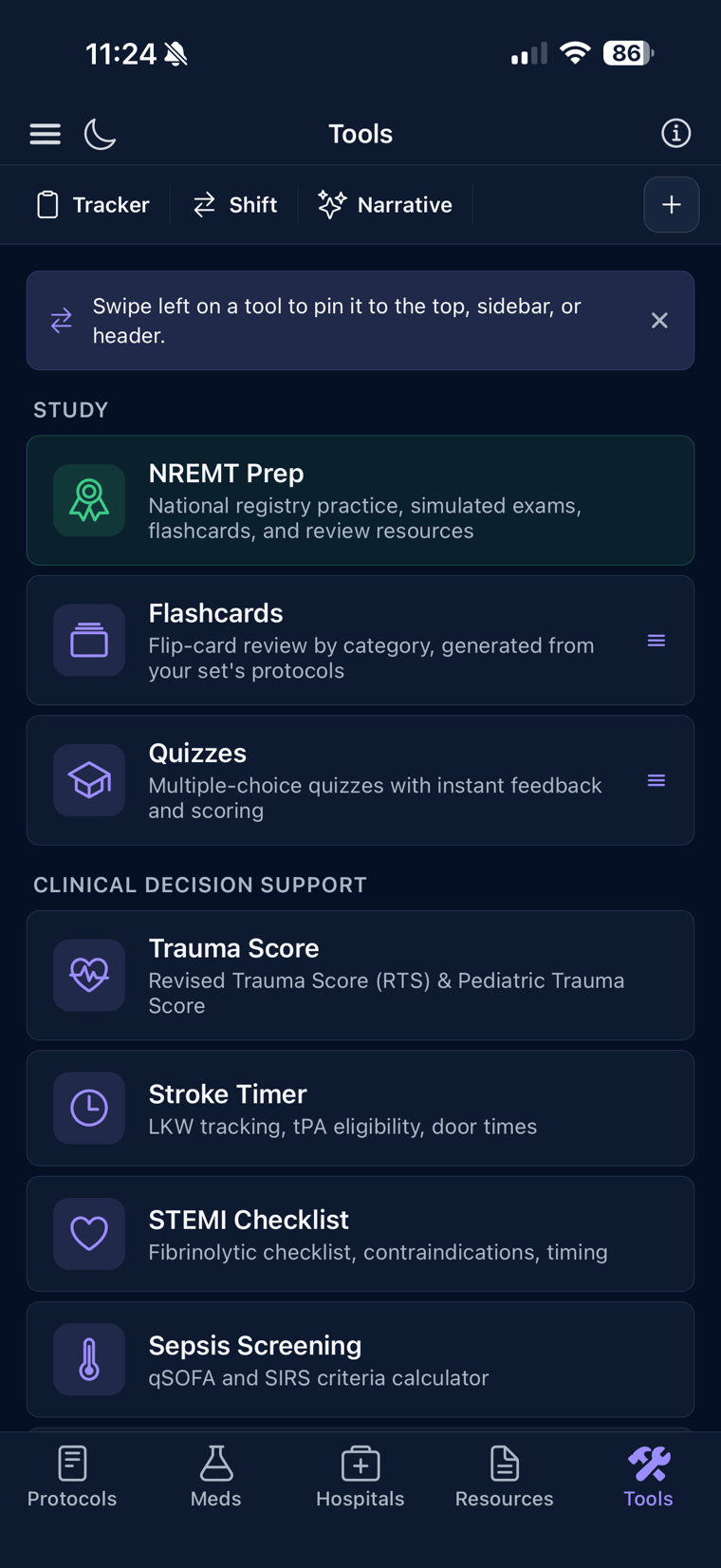
Pocket Protocols showing Indiana's protocols, medications, and hospitals — searchable and fully offline.


What's covered in Indiana
The protocol set serving Indiana right now.
Indianapolis EMS Protocols
Study tools for Indianapolis EMS Protocols
A few real flashcards and quiz questions from Indiana's own protocols — the full set, plus a spaced-review deck, is in the app.
Flashcards
What is a PICC line and where is it inserted?
Suprapubic Pressure: Anatomical Landmark
Primary needle decompression landmark: anatomical location
Defining 'Torso' in Non-Compressible Torso Trauma
EtCO2 threshold for evaluating CPR quality during cardiac arrest
Bradycardia Definition: Heart Rate Thresholds by Age
Indication for Alternate Vector Defibrillation
Cardiogenic Shock: Diagnostic Criteria
Quiz questions
According to the cardiac arrest protocol, what action should be taken immediately after a defibrillation shock is delivered?
- Pause to check for a pulse before resuming compressions
- ✓ Immediately resume chest compressions
- Analyze the rhythm for 10 seconds to confirm conversion
- Administer epinephrine before resuming compressions
According to the Bradycardia protocol, which of the following best defines symptomatic bradycardia requiring escalation of care?
- Heart rate < 60/min with nausea and diaphoresis
- ✓ Bradycardia with signs of poor perfusion, altered mentation, chest pain or dyspnea with associated hypotension
- Any bradycardia in a patient over 65 years of age with a history of cardiac disease
- Heart rate < 50/min with complaint of fatigue and weakness
Alternate Vector Defibrillation is indicated when a patient has refractory ventricular fibrillation or pulseless ventricular tachycardia that has not responded to how many standard defibrillation attempts?
- At least 1 standard defibrillation attempt
- At least 2 standard defibrillation attempts
- ✓ At least 3 standard defibrillation attempts
- At least 5 standard defibrillation attempts
According to the Cardiogenic Shock protocol, which of the following heart rate ranges defines the criteria for this presentation?
- 40–100 beats per minute
- ✓ 60–150 beats per minute
- 50–120 beats per minute
- 80–160 beats per minute
You arrive on scene to find a patient who is apneic and pulseless. The patient's skin shows dependent lividity and the body is rigid. What is the most appropriate action?
- Begin CPR immediately and reassess after 2 minutes
- ✓ Withhold CPR, contact appropriate authorities, and complete a patient care report
- Begin CPR and contact medical direction for guidance
- Withhold CPR only if a valid DNR is also present
According to the external pacemaker protocol, which of the following best describes the criteria for a patient to be a candidate for transcutaneous pacing?
- Any patient with a heart rate below 60 bpm regardless of blood pressure or symptoms
- ✓ A patient 18 years or older with non-traumatic, atropine-refractory symptomatic bradycardia, HR < 60/min, SBP < 90 mmHg, and signs/symptoms of shock
- A patient of any age with traumatic bradycardia unresponsive to atropine
- A patient 18 years or older with symptomatic bradycardia that responded partially to atropine
Sourced from Indiana's EMS authority
Pocket Protocols brings Indiana's EMS protocols into a faster, fully offline app.
Indiana protocols — FAQ
Are Indiana's EMS protocols available offline?
Are the protocols specific to my county in Indiana?
Is Pocket Protocols official, or affiliated with Indiana?
How do Indiana protocol updates reach the app?
Carry Indiana's protocols on every call.
Download Pocket Protocols and keep your county's complete protocol set in your pocket — online or off.