Live in Ontario
Ontario EMS protocols,
Ontario EMS protocols,
in your pocket.
Offline, county-specific protocols for Ontario EMS providers — searchable, with a full medication reference, hospital finder, and study tools built in.
Protocols current as of June 8, 2026
See it in the field
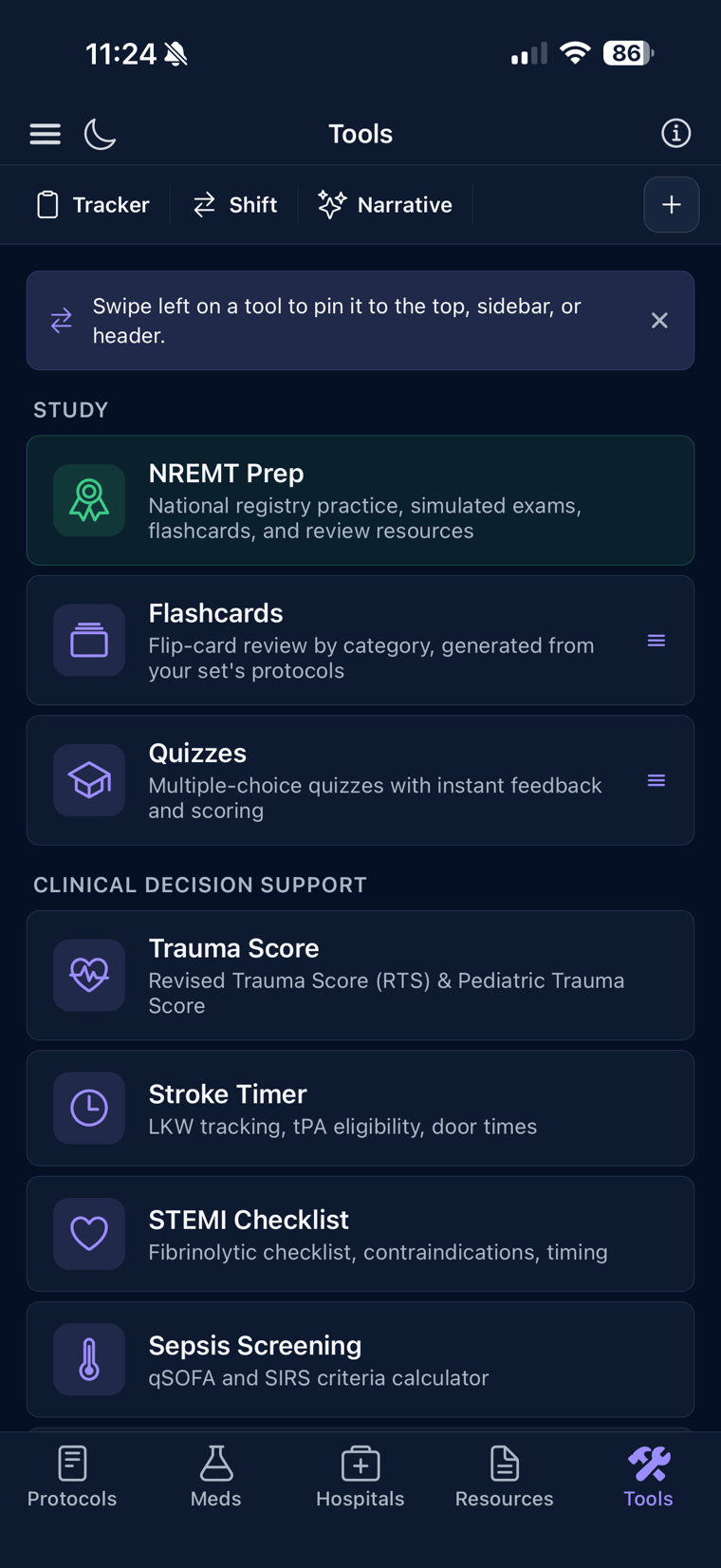
Pocket Protocols showing Ontario's protocols, medications, and hospitals — searchable and fully offline.
What's covered in Ontario
The protocol sets serving Ontario right now.
Ontario ALS Patient Care Standards
Version 5.4 ↗
PDF document
295
Flashcards
175
Quiz questions
33
Medications
11
Resources
Ontario BLS Patient Care Standards
Version 3.4 ↗
PDF document
271
Flashcards
186
Quiz questions
10
Resources
Study tools for Ontario ALS Patient Care Standards
A few real flashcards and quiz questions from Ontario's own protocols — the full set, plus a spaced-review deck, is in the app.
Flashcards
Medical Cardiac Arrest – Indication
This directive applies to non-traumatic cardiac arrest. A Primary Care Paramedic may provide the prescribed treatments if authorized.
Definition of Refractory VF / Pulseless VT
Refractory VF or pulseless VT is defined as persistent VF or pulseless VT after 3 consecutive shocks. For these patients, DSED (if authorized) or VCD (if DSED is unavailable/not authorized) should be considered, followed by transport after 3 doses.
ECG findings suggestive of hyperkalemia
Wide and bizarre QRS complexes (≥120 ms), peaked T waves, loss of P waves, and/or a QRS complex with a 'sine wave' appearance. A 12-lead ECG should be acquired in the non-arrest patient to establish QRS duration before and after treatment.
Right Ventricular MI: how to suspect and confirm
Right Ventricular MI should be suspected in all inferior STEMIs. Confirmation requires at minimum lead V4R, with ST-elevation ≥1 mm in V4R considered diagnostic. Nitroglycerin must NOT be administered to patients with Right Ventricular STEMI.
Indications for the Cardiogenic Shock Medical Directive
The patient must have a STEMI-positive 12-lead ECG AND cardiogenic shock. Both conditions must be present for this directive to apply.
Cardiogenic Shock (0.9% NaCl bolus) indications and key conditions
Indicated for patients with STEMI AND cardiogenic shock. Conditions include hypotension (SBP) and chest auscultation clear. Contraindicated in fluid overload or SBP (specific threshold not stated in source).
Medical TOR – Contraindications
Medical TOR is contraindicated in patients with pregnancy presumed to be ≥ 20 weeks gestation, suspected hypothermia, airway obstruction, and non-opioid drug overdose/toxicology.
Medical Termination of Resuscitation (TOR): three required criteria
A Medical TOR may be considered when ALL three of the following are met: (1) arrest was not witnessed by a paramedic, (2) no ROSC after 20 minutes of resuscitation, AND (3) no defibrillation was delivered.
Quiz questions
A 58-year-old male presents with chest pain and diaphoresis. His 12-lead ECG shows an inferior STEMI. His SBP is 108 mmHg. Before administering nitroglycerin, which action is MOST critical according to the protocol?
- Administer nitroglycerin immediately since SBP is ≥ 100 mmHg
- ✓ Perform lead V4R to rule out Right Ventricular MI before giving nitroglycerin
- Withhold nitroglycerin entirely because any STEMI is a contraindication
- Administer ASA first and then give nitroglycerin without further assessment
You are managing a 45-year-old in cardiac arrest with refractory VF. Three consecutive standard shocks have already been delivered by paramedics. You are authorized to use DSED. Which of the following is a contraindication to applying the Medical TOR rule for this patient?
- No ROSC after 20 minutes of resuscitation
- Arrest not witnessed by a paramedic
- No defibrillation delivered
- ✓ Suspected hypothermia
A 45-year-old male has just achieved ROSC after cardiac arrest. He is hypotensive and his chest auscultation is clear. Which condition must ALSO be confirmed before administering a 0.9% NaCl fluid bolus?
- Patient must be 8 years of age or older.
- There must be no signs of tachydysrhythmias.
- ✓ Chest auscultation must be clear AND hypotension must be present.
- IV/IO/CVAD access must already be established prior to ROSC.
You respond to a 45-year-old patient in cardiac arrest. After 3 consecutive shocks, the patient remains in ventricular fibrillation. DSED is not authorized in your service area. What is the most appropriate next step according to the Medical Cardiac Arrest protocol?
- Immediately initiate transport without further defibrillation attempts
- ✓ Perform Vector Change Defibrillation (VCD) and transport after 3 doses of VCD
- Continue standard defibrillation every 2 minutes until ROSC
- Administer EPINEPHrine and continue standard defibrillation
According to the Cardiogenic Shock Medical Directive, what is a listed condition for administering the 0.9% NaCl fluid bolus in a STEMI cardiogenic shock patient?
- ✓ Chest auscultation is clear
- SBP must be greater than 100 mmHg
- Heart rate must be below 60 bpm
- Patient must have a prior history of nitroglycerin use
You respond to a 52-year-old female with a known history of SVT. She presents with a narrow complex, regular tachycardia at 172 bpm and a BP of 78/50 mmHg, with altered mental status and ongoing chest pain. Which treatment is most appropriate per the Tachydysrhythmia Medical Directive?
- Valsalva maneuver followed by adenosine
- Amiodarone 150 mg IV infusion over 10 minutes
- ✓ Patch to BHP for authorization, then proceed with synchronized cardioversion
- Lidocaine 1.5 mg/kg IV
Sourced from Ontario's EMS authority
Pocket Protocols brings Ontario's EMS protocols into a faster, fully offline app.
Ontario protocols — FAQ
Are Ontario's EMS protocols available offline?
Yes. Download the protocol set for your area once and every protocol, medication, and hospital is available with no signal — built for basements, rural calls, and dead zones.
Are the protocols specific to my county in Ontario?
Pocket Protocols covers selected areas in Ontario today, not the whole state. Protocol sets are scoped by county, so a provider in a covered county gets exactly the set that governs where they respond, and you can add more than one if you work across areas. Other counties are added as their EMS authorities come on board.
Is Pocket Protocols official, or affiliated with Ontario?
No — Pocket Protocols is an independent app and isn't affiliated with or endorsed by any EMS authority. We bring Ontario's protocols into a faster, fully offline app and link the authority's own source for every set.
How do Ontario protocol updates reach the app?
When the EMS authority publishes a new version and it goes live in Pocket Protocols, the app refreshes automatically — crews are never working from a stale copy. We monitor official sources for changes every day.
Carry Ontario's protocols on every call.
Download Pocket Protocols and keep your county's complete protocol set in your pocket — online or off.