Live in Oregon
Oregon EMS protocols,
Oregon EMS protocols,
in your pocket.
Offline, county-specific protocols for Oregon EMS providers — searchable, with a full medication reference, hospital finder, and study tools built in.
Protocols current as of October 27, 2026
See it in the field
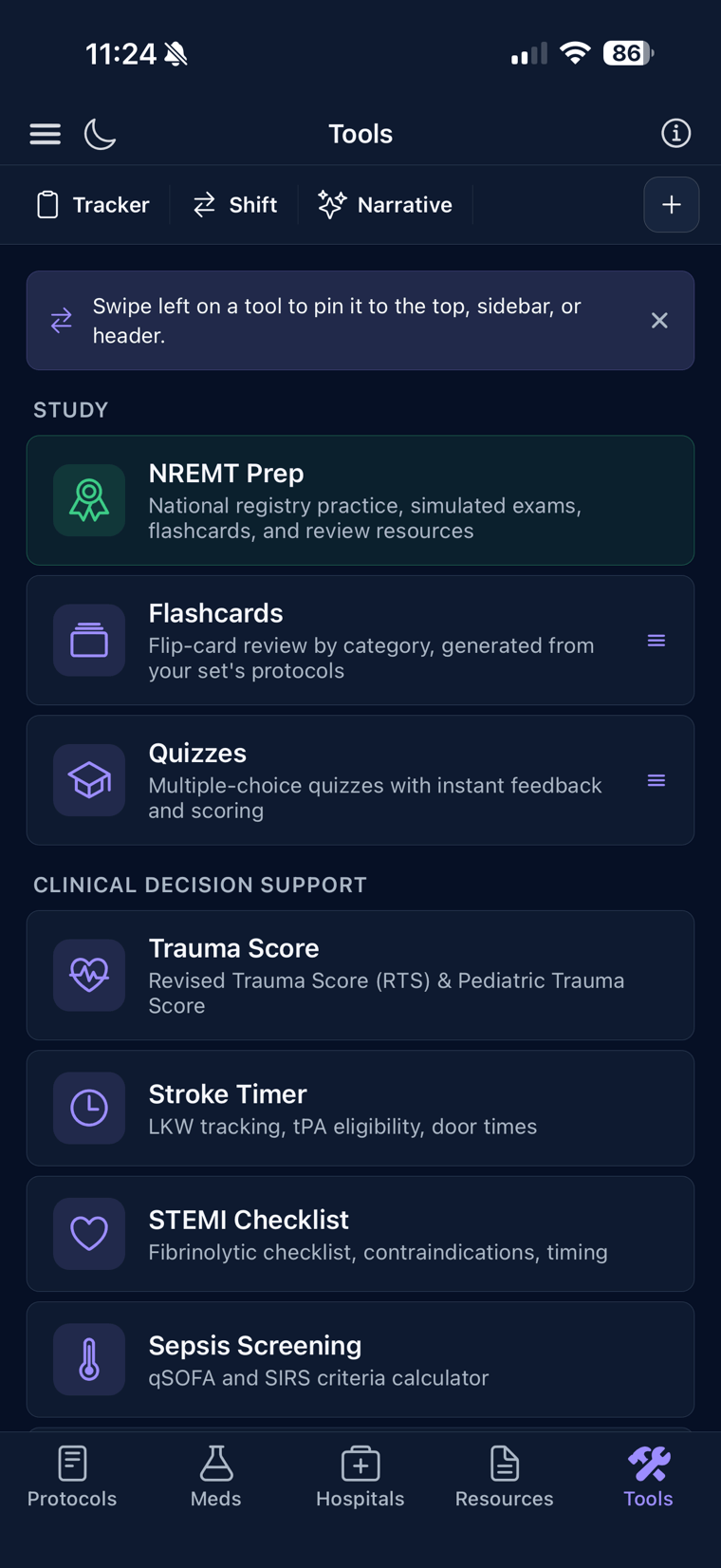
Pocket Protocols showing Oregon's protocols, medications, and hospitals — searchable and fully offline.
What's covered in Oregon
The protocol set serving Oregon right now.
Multnomah County EMS Protocols
January 2026 ↗
PDF document
1,110
Flashcards
585
Quiz questions
55
Medications
10
Resources
Study tools for Multnomah County EMS Protocols
A few real flashcards and quiz questions from Oregon's own protocols — the full set, plus a spaced-review deck, is in the app.
Flashcards
Abdominal Pain (10.010): differential diagnosis for RUQ and epigastric pain
RUQ: cholecystitis, hepatitis, pancreatitis. Epigastric: peptic ulcer, pancreatitis, gastritis.
Abdominal Pain (10.010): differential diagnosis for RLQ and LLQ pain
RLQ: appendicitis, kidney stone, PID, ovarian cyst, cystitis. LLQ: diverticulitis, kidney stone, PID, ovarian cyst, cystitis.
10.078 Eye exam: visual acuity
Assess visual acuity in each eye separately.
Cardiac Arrest (10.050): adult CPR rate, interruptions, ventilation ratio and pad placement
Initiate CPR at 100-120 compressions per minute; any interruption should ideally be < 5 seconds. Ventilate adults at 30:2 (30 compressions to 2 breaths). Use anterior-posterior placement for the initial set of pads; place the second set anterior-lateral when available.
Cardiac Arrest (10.050): rhythms listed under Pulseless Electrical Activity
Electromechanical dissociation, idioventricular rhythm, ventricular escape rhythm, pulseless bradycardic rhythm, and post defibrillation idioventricular rhythm.
Cardiac Dysrhythmias (10.060): adult stable tachycardia, narrow QRS (≤ 0.12 sec) regular rhythm
Consider Valsalva or modified Valsalva maneuver, then adenosine 6 mg rapid IV/IO, then adenosine 12 mg rapid IV/IO, then adenosine 12 mg rapid IV/IO.
Adenosine drug page (20.020): adult PSVT dose sequence
6 mg, 12 mg, 12 mg rapid IV, IO via a large proximal IV line with fluid bolus flush.
Amiodarone drug page (20.040): adult V-fib/pulseless V-tach dose
300 mg IV, IO bolus. If VF/VT persists, repeat once with 150 mg IV/IO push.
Quiz questions
Per 00.020, a medical cardiac arrest patient in PEA has an EtCO2 below 10 after 20 minutes of ACLS resuscitation. What does the protocol allow?
- Resuscitation must continue regardless of EtCO2
- Only the medical examiner may stop resuscitation
- ✓ Death in the field may be determined
- The patient must be treated and transported
Per the 10.050 Paramedic/EMT-Intermediate VF/pulseless VT algorithm, which drugs are given after the 2nd shock?
- Esmolol 500 mcg/kg IV/IO
- Amiodarone 150 mg IV/IO only
- ✓ 1:10,000 epinephrine 1 mg IV/IO and amiodarone 300 mg IV/IO
- Lidocaine 1.5 mg/kg IV/IO
Adenosine drug page (20.020): What is the adult adenosine dose sequence for PSVT?
- 12 mg, 12 mg, 12 mg
- 0.1 mg/kg then 0.2 mg/kg x 2
- ✓ 6 mg, 12 mg, 12 mg
- 6 mg, 6 mg, 12 mg
Amiodarone drug page (20.040): An adult in V-fib remains in V-fib after amiodarone 300 mg. What repeat dose is listed?
- ✓ 150 mg once
- 5 mg/kg
- No repeat is allowed
- 300 mg
Aspirin drug page (20.050): A patient with ischemic chest pain already took one baby aspirin this morning. What does the drug page say?
- Aspirin is contraindicated
- ✓ Give 324 mg PO; it can be given even if the patient has taken ASA that day
- Give 81 mg only
- Contact OLMC before any aspirin
Atropine drug page (20.060): What is the maximum adult atropine dose for bradycardia?
- 5 mg
- 1 mg
- ✓ 3 mg
- 0.5 mg
Sourced from Oregon's EMS authority
Pocket Protocols brings Oregon's EMS protocols into a faster, fully offline app.
Oregon protocols — FAQ
Are Oregon's EMS protocols available offline?
Yes. Download the protocol set for your area once and every protocol, medication, and hospital is available with no signal — built for basements, rural calls, and dead zones.
Which protocol sets are available in Oregon?
The available protocol sets for Oregon are listed on this page with their formats and official sources. Coverage varies by set and does not necessarily include every area or agency. Check that a listed set applies to your agency before downloading.
Is Pocket Protocols official, or affiliated with Oregon?
No — Pocket Protocols is an independent app and isn't affiliated with or endorsed by any EMS authority. We bring Oregon's protocols into a faster, fully offline app and link the authority's own source for every set.
How do Oregon protocol updates reach the app?
When the EMS authority publishes a new version and it goes live in Pocket Protocols, the app refreshes automatically — crews are never working from a stale copy. We monitor official sources for changes every day.
Carry Oregon's protocols on every call.
Download Pocket Protocols and keep your county's complete protocol set in your pocket — online or off.